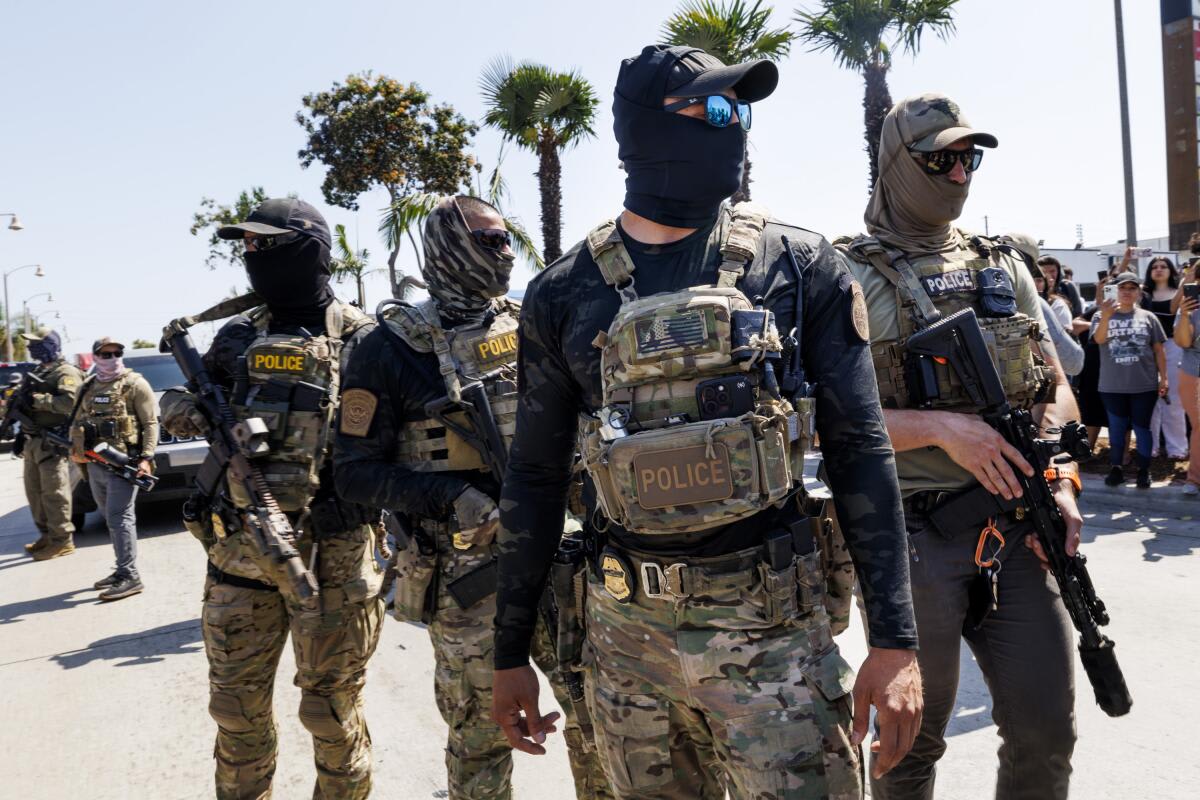
Court documents outline the use of facial recognition technology in conjunction with undercover operations and intelligence collection.
Released court documents [1] reveal that Homeland Security Investigations utilized [2] Clearview AI's facial recognition technology as part of a larger undercover operation. This operation involved infiltrating activist groups, monitoring encrypted communications, and compiling intelligence files on individuals protesting immigration enforcement in Minnesota.
Homeland Security Investigations or HSI, [3] the investigative division of Immigration and [4] Customs Enforcement or ICE, deployed undercover agents to attend community meetings and activist groups as part of Operation Metro Surge. The agents covertly recorded discussions, accessed private Signal chats, gathered vehicle data, and examined financial connections involving labor unions and progressive organisations.
On September 2025, US Immigration and Customs Enforcement’s Homeland Security Investigations [5] concluded a $9.2 million contract with a company based in New York, which includes an upfront payment of $3.75 million. The agreement will utilize Clearview’s biometric matching software for two specific investigative purposes: cases related to child sexual exploitation and investigations concerning assaults on law enforcement personnel.
The documents were released as part of a discovery motion filed for Isaac Sant, one of 15 defendants accused of conspiring to obstruct federal immigration officers. Sant's legal team reported that the government provided at least two search reports from Clearview AI in the case, one of which yielded photographs of a different individual as potential matches and included images from Facebook showing that individual's wife and child. Sant's attorneys are requesting additional records from the government, arguing that these are essential to assess the extent of the surveillance and to determine if individuals participating in protected First Amendment activities were included in federal investigations without sufficient criminal justification.
The government's investigative files indicate that the undercover operation was significantly more extensive than the visible confrontations between immigration agents and observers that garnered national attention earlier this year. Records show that Homeland Security Investigations [6] initiated Operation Puppet Master on January 28, granting permission for undercover agents to infiltrate groups and gatherings that the agency considered a potential threat to federal officers.
In February 2015, a 2nd investigation [7] known as Project Whipple Shield commenced, aiming to uncover the organizational frameworks and financial backing related to activities the government linked to violence, property damage, intimidation, or disruption of federal operations.
Court documents reveal that undercover officers from the US Department of Homeland Security infiltrated community meetings at churches, parks, libraries, and schools by posing as protesters. They recorded interactions among attendees and accessed encrypted communications utilized by activists. Rev. Jen Crow, [8] senior minister at First Universalist Church of Minneapolis, said “We are calling on other communities of faith on our elected officials, on Minnesota businesses to stand together, to say no to political surveillance and intimidation, to say yes to holding together as a community, to caring for one another.”
One particular agent operated under the pseudonym “peanutbutterjelly” in communications via Signal with group organizers. During a meeting of the Sunrise Movement, the agent noted that members described their upcoming demonstrations as peaceful. However, according to a defence filing, the agent suggested to one participant that he possessed construction skills that could aid in executing more aggressive direct actions and expressed a willingness to accept the risk of arrest. This offer was ultimately declined by the participant.
In July 2026, a lawsuit [9] claims that federal immigration agents regularly captured photographs and videos of individuals, their vehicles, and license plates while they were monitoring immigration operations. The federal lawsuit alleges that DHS collected facial images, license plate information, and identities of individuals who were peacefully observing immigration enforcement actions. The lawsuit claims that this information was subsequently used to revoke their Global Entry and Transportation Security Administration PreCheck privileges.
The 55-page complaint was submitted in the US District Court for the Southern District of California [10] by the Electronic Privacy Information Centre, along with 3 US citizens. The plaintiffs contend that federal agents photographed, scanned, or identified them during their observations of immigration operations. Federal law allows for undercover investigations and the collection of intelligence in relation to legitimate law enforcement objectives. However, [11] the Privacy Act of 1974 places limitations on the government's ability to maintain records that detail individuals' exercise of First Amendment rights unless such information is relevant to an authorized law enforcement activity. The legality of Operation Metro Surge in this context is expected to be a key issue as Sant's case moves forward.
- https://s3.documentcloud.org/documents/28554313/mn15_motion_aug13_with_exhibits.pdf
- https://www.clearview.ai/
- https://www.ice.gov/hsi
- https://www.ice.gov/
- https://www.usaspending.gov/award/CONT_AWD_70CMSD25P00000111_7012_-NONE-_-NONE-
- https://www.democracynow.org/2026/8/17/operation_puppet_master
- https://www.cbsnews.com/minnesota/news/twin-cities-leaders-condemn-federal-surveillance-operation-metro-surge/
- https://firstuniversalistchurch.org/about-us/staff/
- https://democracyforward.org/wp-content/uploads/2026/07/2026-07-24-1-Complaint.pdf
- https://epic.org/biometric-update-dhs-accused-of-tracking-immigration-observers-and-retaliating-through-global-entry/
- https://home.treasury.gov/footer/privacy-act